
InBody Scan & Fitness Assessment in NYC
Momentum Fitness runs the InBody 570 body composition analyzer at our Upper West Side gym, one block from the 72nd Street subway (1/2/3 and B/C). Anyone in New York can book an InBody scan for $50, no training commitment required. Personal training clients get more: a complete two-part fitness assessment, the InBody scan plus a Functional Movement Screen, free and built into onboarding.
InBody Scans in NYC, No Training Required
Most InBody machines in New York sit inside physical therapy clinics, nutrition practices, and hospital performance labs. Ours is in a gym, and it's open to anyone. If you train somewhere else, work with a nutritionist, or just want real numbers instead of a bathroom scale's guess, you can book a scan and be out the door in fifteen minutes.
Book Your InBody Scan
Single scans are $50. A 5-pack is $200, which brings it to $40 per scan. Scans are by appointment: call or text (917) 426-3492 or email info@momentumfitnessnyc.com. Momentum doesn't sell memberships, so there's nothing to join and nothing that renews. You pay for the scan and get the data.
Accurate body composition in under a minute
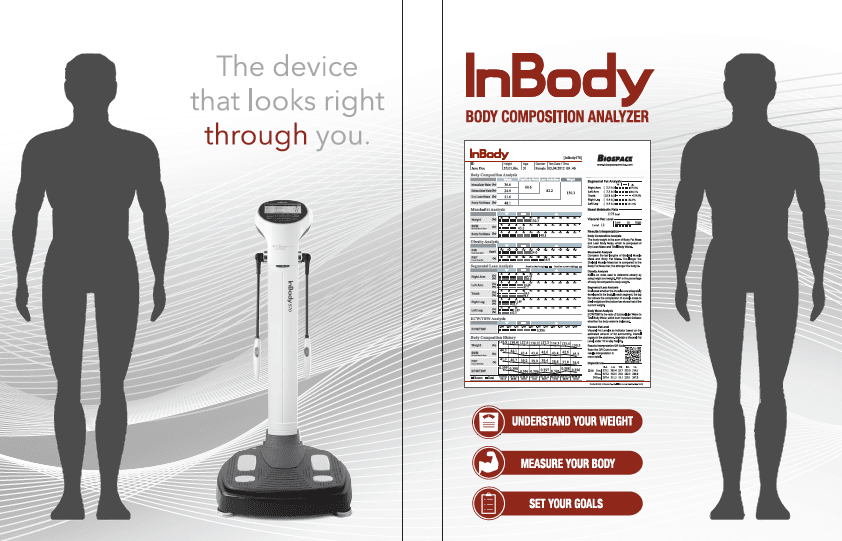
Step on the InBody 570 scanner, hold the hand electrodes, and stand still for about 45 seconds. You walk out with a printed report the same visit.
Every scan is saved to your profile, so when you come back next month or next year, you compare results side by side.
Who books standalone InBody scans
- People whose nutritionist or dietitian asked for a body composition test
- Runners and athletes tracking lean mass through training cycles
- Fat loss clients who want to confirm they're losing fat, not muscle
- Strength trainees who want to prove the scale going up means muscle, not fat
- Anyone tired of guessing from a bathroom scale
What a Body Composition Analysis Tells You
A scale gives you one number and no context. You can lose fat and gain muscle at the same time, and the scale will barely move. Body composition analysis catches what the scale misses: a real body fat measurement instead of a formula's estimate. The InBody 570 uses bioelectrical impedance analysis (BIA) to measure how your weight actually breaks down.
What your InBody report shows
- Body fat percentage (fat vs. lean mass)
- Segmental muscle balance (left vs. right, upper vs. lower)
- Basal metabolic rate (calories burned at rest)
- Total body water and hydration balance
- Visceral fat level
- Progress history across every scan on file
It has a 98% correlation with DEXA scans, which makes it one of the most accurate body composition tools available outside a clinical lab, at a fraction of what NYC labs charge for DEXA or BOD POD testing.
How to Prepare for Your InBody Scan
BIA measures the body's water to calculate everything else, so consistent conditions matter more than perfect conditions. Come normally hydrated, and avoid a heavy meal or a hard workout in the couple of hours before your scan. Skip lotions or oils on your hands and feet, since they interfere with the electrodes. Wear comfortable clothing you can move in. If you're tracking progress across multiple scans, book them at roughly the same time of day under the same conditions; that's what makes the trend line trustworthy.
The Full Fitness Assessment, Free with Personal Training
Every new personal training client at Momentum goes through a two-part assessment before programming begins. It's included in your package and run by your trainer, and it gives us a real baseline instead of a guess.
Part 1: InBody 570 Body Composition Analysis
The InBody 570 uses bioelectrical impedance analysis to measure body fat percentage, lean muscle mass, basal metabolic rate, and segmental muscle balance in about 45 seconds.
For training clients the scan is free, and your numbers are on file from day one, so progress gets measured instead of assumed and your program starts from your real starting point.
Part 2: Functional Movement Screen (FMS)
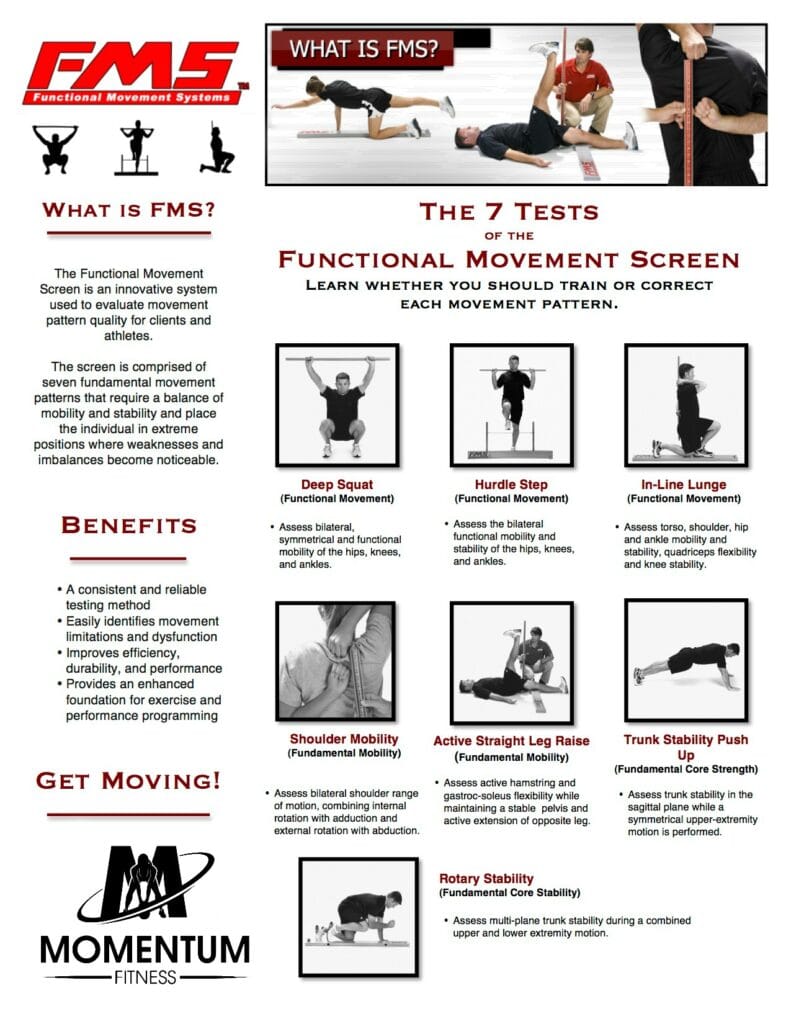
The Functional Movement Screen is a seven-test movement screening used by trainers across NYC to evaluate mobility, stability, and fundamental movement patterns. Your trainer watches how you squat, step, lunge, reach, and rotate, the same patterns that show up in every workout, and scores each one.
The FMS isn't a medical diagnosis. It won't tell you whether something is injured. What it does tell us is where your movement has limitations so we can program around them, correct them over time, and keep you training safely from day one. The screen is run by trainers certified in the FMS.
Why we run the FMS on every client
- It flags movement limitations that could cause injury under load
- It lets us program the right regressions or progressions from session one
- It gives us a re-test to measure later, so you can see movement quality improving, not just weight on the bar
- It's the reason our trainers can work with beginners, post-rehab clients, and advanced lifters under the same roof
Flexibility, Balance, and Strength: What Else Gets Measured
A comprehensive fitness assessment is more than a body scan. The FMS doubles as functional flexibility and balance testing: several of its seven patterns specifically expose limited range of motion, asymmetries, and stability problems you'd never notice until they show up under load. Strength baselines get set in your first coached sessions, where your trainer establishes working weights for the fundamental lifts and tracks them from there. Between the scan, the screen, and those baselines, you and your trainer both know exactly where you're starting, and every re-test after that is proof of progress instead of a feeling.
Not Training With Us Yet?
Your first session is complimentary. Meet a trainer, tour the gym, and see if Momentum is the right fit.
Book Your Free SessionFrequently Asked Questions
The questions we hear most about the InBody scan, the movement screen, and what to expect.
Why do I need a fitness assessment?
A fitness assessment gives your trainer a baseline so your program is built around your real starting point, not a guess. It also gives you something measurable to track over time, so progress isn't just about how you feel or what the scale says.
How much does an InBody scan cost in NYC?
At Momentum, a single InBody scan is $50 and a 5-pack is $200 ($40 per scan). For context, DEXA scans in NYC typically run $100 to $250 per scan, and hospital-lab body composition packages cost more. If you're a Momentum personal training client, the scan is free as part of your assessment.
Is the InBody 570 scan accurate?
The InBody 570 has a 98% correlation with DEXA scans, which makes it one of the most accurate body composition tools available outside a clinical setting. One honest caveat: like all bioelectrical impedance devices, readings shift a little with hydration, so a single scan is a very good estimate rather than a lab-grade measurement. Scan under consistent conditions and the trend across scans is what you can trust, which is exactly how we use it.
InBody vs DEXA: which should I get?
They answer different questions. A DEXA scan is the clinical gold standard and also measures bone density, which matters if your doctor ordered it. An InBody scan gets you 98%-correlated body composition data in 45 seconds for a fraction of the price, with every scan saved for side-by-side comparison. If you want a medical measurement, get the DEXA. If you want accurate numbers you'll actually re-check every couple of months, the InBody test is the practical choice.
How often should I get an InBody scan?
Every 4 to 8 weeks is the sweet spot for most goals: long enough for real change to show up, short enough to catch a stalled program early. That's what the 5-pack is for; at that cadence it covers most of a year of progress tracking.
What should I wear to my assessment?
Comfortable workout clothing and athletic shoes. For the InBody scan, avoid applying lotions or oils to your hands and feet beforehand, as they can affect the accuracy of the reading.
How long does the assessment take?
The InBody scan itself takes about 45 seconds. The full two-part assessment runs inside your complimentary first session, alongside goal-setting and a guided workout, so you're training the same day you're assessed.
Will the FMS screening tell me if I have an injury?
No. The Functional Movement Screen is not a diagnostic tool. It identifies movement limitations and imbalances so your trainer can program safely around them, but it does not diagnose injuries. If you suspect an injury, see a physical therapist or doctor.
What happens after my assessment?
Your trainer reviews your InBody results and FMS scores with you, explains what they mean, and uses them to build the first phase of your program. You leave with a clear picture of where you're starting and what you're working toward. That review is the difference between getting a printout and getting a plan.
Can I get an InBody scan without doing personal training?
Yes. Single scans are $50 and 5-packs are $200 ($40 per scan), available by appointment only. To schedule, call or text (917) 426-3492 or email info@momentumfitnessnyc.com.
Do non-clients get the Functional Movement Screen too?
No. The FMS is reserved for personal training clients because the value is in how the results shape your program. Without training follow-through, the screen is just a snapshot. Non-clients can book standalone InBody scans anytime.
Does the InBody 570 track my progress over time?
Yes. Every scan is saved on your profile, so when you come back, whether it's next week or next year, you can compare results side by side and see exactly how your body composition has changed.